


Imagine it’s 2 AM and you need help with something urgent. Waiting until morning seems like forever. That’s where AI-powered chatbots come in. They are changing how we talk to businesses.
The growth of AI chatbots is amazing. By 2025, Gartner says 80% of customer service teams will use them. This change is big and it’s here to stay.
Think about getting answers right away, no matter the time. That’s what AI chatbots offer. They make things faster and better. IBM found that using these tools can cut costs by up to 30% and make customers happier.
A survey shows 62% of people like using chatbots for help more than talking to people. It’s clear: AI chatbots are key in our busy lives.
Introduction to AI-Powered Chatbots
AI bots are changing how we talk to companies online. They are smart tools that have grown a lot since they started. Now, AI chatbots can really understand and talk back to us.
Definition and Functionality
AI chatbots are like computer friends that talk to us. They use smart tech to get what we mean and answer us back. These bots can do lots of things, like help with questions, orders, and even appointments.
Historical Context and Evolution
Chatbots started simple, with set rules. They could only do what they were told. But, as tech got better, chatbots got smarter too.
Today, AI chatbots learn from us and get better at talking. They can even talk to us in a way that feels personal. The chatbot world is growing fast. It went from $190.8 million in 2016 to a huge $1.25 billion by 2025. This shows how much companies are using AI bots to help customers and work better.
Key Benefits of AI-Powered Chatbots
AI-powered chatbots are changing customer service and driving innovation in many fields. They bring many benefits to businesses wanting to better serve their customers and work more efficiently.
Enhanced Customer Engagement
Chatbots answer customer questions fast, cutting wait times by up to 70%. This quick service makes customers happier, with a 30% boost in satisfaction. They can handle over 100 chats at once, much more than humans can.
Cost-Effectiveness
Using chatbots can save businesses a lot of money. They can cut customer service costs by up to 30% and work more efficiently. Chatbots can solve over 80% of customer problems, freeing up humans for harder tasks.
24/7 Availability
AI chatbots are always ready to help, 24/7. This means customers get support anytime, keeping them happy and loyal. In fact, 60% of people like using chatbots for simple tasks.
As technology advances, AI chatbots are key for businesses. They help improve service, cut costs, and stay ahead in the digital world.
How AI-Powered Chatbots Work
AI-Powered Chatbots are changing how we talk to customers. They use new tech to understand and answer questions well. Let’s look at what makes these chatbots work.
Natural Language Processing (NLP)
NLP is key for AI-Powered Chatbots. It lets them get what we mean, even our tone. This tech makes chatbots give answers that feel personal and real.
With NLP, chatbots can tackle tough questions and give right answers fast.

Machine Learning Algorithms
Machine learning makes chatbots better with time. They learn from our questions, getting better at answering. This way, chatbots keep getting smarter and more helpful.
Integration with Existing Systems
AI-Powered Chatbots work well with other customer service tools. They can look up info in company databases. This means they can help with lots of questions.
They can also send tricky questions to people for help. This makes sure customers get the best service.
AI-Powered Chatbots are very good at their job. They’re always ready to help, which 64% of customers like. They answer fast, which is important. A 5-minute wait can hurt lead generation a lot.
Industry Applications of AI-Powered Chatbots
AI bots are changing how we talk to customers in many fields. They are smart tools that meet the needs of each industry.
E-commerce Revolution
In online shopping, AI bots make things better. They suggest products, track orders, and help with customer support. A study found that 75% of shoppers like their experience more with chatbots.
These AI helpers also cut down on people leaving their carts empty. They keep users engaged who might have walked away.
Healthcare Advancements
AI bots are changing healthcare. They help schedule appointments, making confirmations 30% higher. They also check symptoms and remind patients about meds, boosting patient care by 20%.
AI bots are always ready to help, giving patients info and support any time.
Banking and Finance Innovation
In finance, AI bots make things easier. They answer account questions, handle money matters, and give basic financial tips. The Economist says 80% of bank leaders think AI will make some banks stand out.
These smart tools cut down wait times for customer queries by up to 50%. This makes banking better for everyone.
Case Studies Showcasing Success
Chatbot innovation has changed customer service in many fields. Big brands have started using this tech. They see big wins in customer happiness and work flow.
Major Brands Utilizing Chatbots
An electronics store got an 80% CSAT score and 84% engaged sessions with AI chatbots. Their sales jumped to $300 on average. A floral service saw 60% of people finish quizzes and 78% claim prizes with chatbots.
Metrics for Measuring Success
Companies track chatbot success in different ways. MetLife saw a 3.5% jump in first-call solves and 13% more happy customers with AI chatbots. Across the board, chatbots handle 80% of simple questions. This lets humans tackle harder issues.
- 69% of consumers like chatbots for easy questions
- 14% more people engage with chatbots
- 25% faster customer service
- 20% more sales for online shops
These stories show how chatbot tech is changing business. It helps companies make customers happier, work better, and grow in a tough market.
Challenges in Implementing AI-Powered Chatbots
AI-Powered Chatbots have changed customer service. But, they come with big challenges. Businesses face technical and user issues when adding these systems.
Technical Limitations
Natural language processing is very complex. A huge 76% of chatbots can’t handle complex questions right. This makes 50% of users give up after three bad chats.

It’s hard to link these systems with what’s already there for 45% of companies. They need to keep learning and getting better. This is true for 80% of chatbot use, as they need tweaks to answer better.
User Acceptance
Getting users to accept chatbots is tough. Even though 65% like them for quick answers, 55% want a human for big issues. 26% get upset because chatbots don’t seem to care.
Personalized chats are what users want, with 71% expecting it. But, 35% of companies struggle because their chatbots don’t give unique answers.
To beat these problems, businesses need to protect data well. They should make chatbots easy to use and switch to humans when needed. This way, they can really use AI-Powered Chatbots to help customers.
Future Trends in AI-Powered Chatbots
AI bots are changing fast, making smart communication better. The future looks bright, with new ways to talk to tech.
Advancements in AI Technology
Next AI bots will understand complex questions better. They’ll know how you feel and talk back in a way that feels right. This makes talking to them more fun and personal.
AI bots will soon work with augmented and virtual reality. This means we’ll have amazing, real-time experiences. Talking to them will feel natural, like talking to a friend.
Rise of Multilingual Chatbots
AI bots will soon speak many languages. This will help everyone talk to them, no matter where they’re from. It’s great for businesses wanting to reach more people.
The chatbot market is growing fast, to $15.5 billion by 2028. This shows how much we want smart ways to talk to tech. As AI gets better, we’ll see even more cool chatbot ideas.
Best Practices for Businesses
Chatbot innovation is changing how we talk to customers. It’s important for businesses to follow best practices. Making chatbots easy to use and always getting better is key.
Designing User-Friendly Interfaces
It’s crucial to make chatbot interfaces easy for customers. Offering pre-set options for user queries can make things smoother. This can make customers spend up to 67% more.
Continuous Learning and Improvement
Businesses need to keep learning and improving with chatbots. Keeping the knowledge base up to date is important. This makes chatbots give accurate and current answers.
Using these strategies can bring great results:
- Up to 30% more customer interactions
- 20% faster answers to questions
- 25% more sales, especially online
By focusing on easy design and constant improvement, businesses can use chatbots to their fullest. This boosts customer happiness and makes operations more efficient in the tech world.
Measuring Performance and ROI
AI-Powered Chatbots are key for businesses today. They help track how well these tools work. Companies use special tools to watch their performance.
Key Performance Indicators
It’s important to track the right KPIs to see if chatbots are doing well:
- Resolution rate: How many problems are solved by the chatbot alone
- Customer satisfaction scores: What users think of talking to the chatbot
- Average handling time: How fast the chatbot solves problems
- Conversion rates: How well the chatbot helps make sales or get more info
- Cost savings: How much money saved by using the chatbot
Tools for Monitoring Success
There are many tools to keep an eye on chatbot success:
- Analytics platforms: Watch how users interact and how well the chatbot does
- Customer feedback mechanisms: Get what users really think about the chatbot
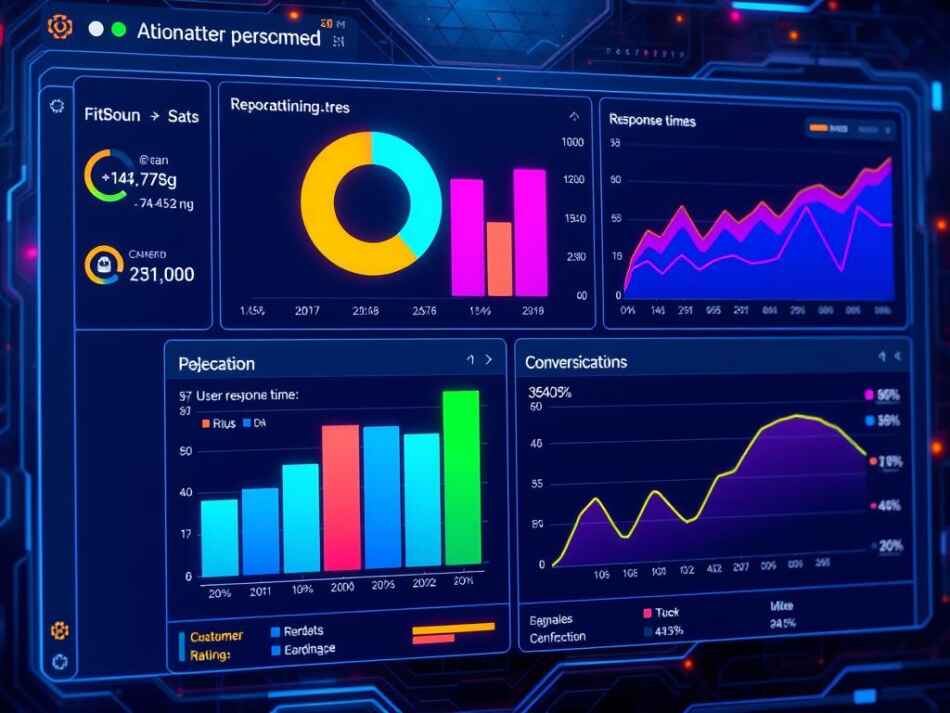
- AI-powered dashboards: See important stats and trends easily
Using AI-Powered Chatbots can really cut down on customer service costs. For example, a call center with 3000 calls a month can save $10,000. This is because a chatbot can handle 2000 of those calls. It shows how much money you can save with these tools.
Compliance and Ethical Considerations
AI bots are changing customer service, but they raise big ethical questions. Tools for smart communication must handle data privacy and AI bias.
Data Privacy Concerns
The growth of AI bots has made people worry about their data. Over 68% of internet users worldwide are concerned about their privacy. Companies using chatbots must be clear about how they use data.
They must follow rules like GDPR and HIPAA for health data AI. Encryption is vital to keep patient info safe. AI chatbots should only get the data they really need.
This helps build trust and keeps users safe from data leaks.
Bias in AI Algorithms
AI bots can sometimes show biases. A 2020 study found 80% of AI data has bias. This can unfairly affect some groups, like minorities.
For example, a healthcare algorithm favored white patients over black ones because of biased training.
To fight bias:
- Use diverse data for training
- Check AI systems for fairness often
- Use tools like FairPy to lessen bias
Companies focusing on ethical AI see a 20% boost in trust. By tackling these issues, businesses can make smarter, more reliable tools.
As AI bots grow in customer service, we must balance new tech with ethics. This way, smart communication helps everyone fairly and safely.
Conclusion: Embracing the Future with AI-Powered Chatbots
AI-powered chatbots are changing how we talk to customers. By 2027, they might be the main way companies talk to customers for a quarter of them. This shows how big chatbot innovation is getting in business.
Using chatbots in business brings big wins. Companies see a 30% drop in customer support costs and a 25% jump in keeping customers. This is because chatbots can answer up to 80% of simple questions. This lets humans focus on harder problems.
Chatbots are getting better thanks to new tech. They can understand more, handle tough questions, and even feel what we’re feeling. This makes talking to them feel more like talking to a person, making customers happier by 10-15%.
But, chatbots also face challenges. These include:
- Working with old systems
- Keeping up in long talks
- Dealing with ethics and keeping data safe
Even with these problems, chatbots have a bright future. The market for them is expected to hit $1.34 billion by 2024. Companies that use them will likely be ahead in serving customers and being efficient.
Additional Resources for Learning
The world of AI-powered chatbots is always changing. To keep up, it’s key to keep learning. This section offers great resources for learning more about customer service tools and AI chatbots.
Recommended Readings
Several books and papers give deep insights into AI chatbots. “The Chatbot Handbook” by Mady Mantha is a detailed guide on making and using chatbots. The journal “Artificial Intelligence Review” shares the latest research on chatbot tech and its use in customer service.
Online Courses and Certifications
Many online sites have courses on AI and chatbot making. Coursera’s “AI for Everyone” by Andrew Ng is great for newbies. The “AI-Powered Customer Service” certification by IBM on edX goes deeper into using AI chatbots in customer service.
Emily Potosky, Director of Research at Gartner Customer Service & Support practice, talks about the rise of self-automation in customer service. This shows why learning never stops in this field. Using these resources, professionals can improve their skills and lead in customer service tools and AI chatbots.
FAQ
Q: What are AI-powered chatbots?
Q: How do AI-powered chatbots benefit businesses?
Q: In which industries are AI-powered chatbots commonly used?
Q: What are the key technologies behind AI-powered chatbots?
Q: What challenges do businesses face when implementing AI-powered chatbots?
Q: How can businesses measure the success of their AI-powered chatbot implementations?
Q: What are some emerging trends in AI-powered chatbot technology?
Q: What ethical considerations should businesses keep in mind when using AI-powered chatbots?
Source Links
- https://www.forbes.com/councils/forbesbusinesscouncil/2024/08/22/customer-service-how-ai-is-transforming-interactions/ – Council Post: Customer Service: How AI Is Transforming Interactions
- https://www.netguru.com/blog/ai-chatbots-improving-customer-service – How AI Chatbots Are Improving Customer Service
- https://indigo.ai/en/blog/customer-service-chatbots/ – Enhancing Customer Service with AI-Powered Chatbots
- https://www.salesloft.com/learn/ai-chatbots – An Introduction to AI Chatbots and Natural Language Processing
- https://www.ibm.com/think/topics/chatbots – What Is a Chatbot? | IBM
- https://teachingcommons.stanford.edu/teaching-guides/artificial-intelligence-teaching-guide/defining-ai-and-chatbots – Defining AI and chatbots
- https://www.ibm.com/think/insights/unlocking-the-power-of-chatbots-key-benefits-for-businesses-and-customers – Benefits of Chatbots | IBM
- https://www.zendesk.com/blog/5-benefits-using-ai-bots-customer-service/ – Top 22 benefits of chatbots for businesses and customers
- https://www.netguru.com/blog/improve-chatbot-with-artificial-intelligence – AI Chatbot: How Artificial Intelligence and Machine Learning Can Improve Your Chatbot
- https://capacity.com/learn/ai-chatbots/how-does-an-ai-chatbot-work/ – How does an AI chatbot work, and what does it mean for the future?
- https://cloud.google.com/use-cases/ai-chatbot – AI chatbot
- https://datanorth.ai/blog/the-benefits-of-ai-chatbots – The Benefits of AI Chatbots in 6 Different Industries – DataNorth
- https://devrev.ai/blog/ai-chatbots – AI Chatbots: Definition, Examples, and Use Cases
- https://chat360.io/blog/applications-of-chatbots/ – Application of Chatbot: Transform Your Business with AI in 2024
- https://masterofcode.com/blog/generative-ai-for-customer-experience – Generative AI for Customer Experience: 17 Cases from Global Brands
- https://durapid.com/top-25-chatbot-case-studies/ – Top 25 Chatbot Case Studies & Success Stories – Durapid
- https://tech-stack.com/blog/future-of-chatbots/ – The Evolution of AI Chatbot Development with Key Trends and Future Prospects
- https://www.contactfusion.co.uk/the-challenges-of-using-ai-chatbots-problems-and-solutions-explored/ – The Challenges of Using AI Chatbots: Problems and Solutions
- https://primathon.in/blog/future-trends-in-ai-chatbot-technology/ – Future Trends in AI Chatbot Technology
- https://www.chatbot.com/blog/future-of-conversational-ai/ – The Future of Conversational AI: Trends for 2024 and Beyond
- https://blog.getodin.ai/future-of-chatbots/ – The Future of Chatbots: Trends, Innovations, & Insights for 2024
- https://www.lindy.ai/blog/chatbot-best-practices – 12 Chatbot Best Practices for Your Business | Lindy
- https://builtin.com/artificial-intelligence/designing-effective-ai-chatbots – Best Practices for Designing Effective AI Chatbots | Built In
- https://www.tidio.com/blog/chatbot-best-practices/ – 10 Essential Chatbot Best Practices & Tips for Your Business
- https://aisera.com/blog/roi-with-ai/ – ROI with AI | Key Factors for Measuring AI Investment
- https://botpress.com/blog/roi-for-chatbots – How to Calculate ROI for 3 Types of Chatbots
- https://scrumdigital.com/blog/why-measuring-roi-is-important-for-ai-chatbot-implementation/ – Why Measuring ROI is Important for AI Chatbot Implementation.?
- https://smythos.com/artificial-intelligence/chatbots/chatbots-and-ethical-considerations/ – SmythOS – Chatbots and Ethical Considerations: Navigating Privacy, Transparency, and Trust
- https://www.ptolemay.com/post/building-trust-in-the-ai-era-ethical-considerations-for-chatbot-integration – AI Chatbot Costs and Ethics: Plan Your Project Effectively
- https://www.trustshoring.com/blog/the-ethical-considerations-of-ai-powered-chatbots-in-healthcare/ – The Ethical Considerations of AI-Powered Chatbots in Healthcare
- https://smythos.com/artificial-intelligence/chatbots/chatbots-future-trends/ – SmythOS – Chatbots Future Trends: The Evolution of Chatbots in Business and Beyond
- https://www.mindbank.ai/articles/the-future-is-here-unleashing-the-power-of-ai-in-online-chat – The Future is Here: Unleashing the Power of AI in Online Chat
- https://cte.ku.edu/prompting-ai-chatbots – Prompting AI chatbots
- https://teach.ufl.edu/resource-library/chatbots-and-artificial-intelligence-in-education/ – Chatbots and Artificial Intelligence in Education | Center for Teaching Excellence
- https://educationaltechnologyjournal.springeropen.com/articles/10.1186/s41239-023-00426-1 – Role of AI chatbots in education: systematic literature review – International Journal of Educational Technology in Higher Education